Glitter
Case Study 02
Design

Where the designstarts to shine

Designing a member portal web app experience worthy of the streets it serves, inside the constraints of a no-code platform, an established brand, and a lean team.

Role

Product Manager/Designer

Timeline

April 2024 – September 2025

Skills

Product strategy, UX design, UI Design

Context

About Glitter

Glitter is a social impact cleaning service based in Philadelphia. They facilitate neighbor-funded cleanups for city blocks, hiring and paying a living wage to cleaners who often have barriers to work. The work is hyper-local by design: each city block has its own funding status, its own community, and its own story to tell.

As Product Manager, I owned the 0→1 build of Glitter's member portal web app — from tool selection and data strategy through design, iteration, and launch.

1k+

City blocks and users in a dynamic, on-brand member portal web app, each auto-generated from a single data source

0→1

Full product built from scratch, no custom dev, in-house maintained, scalable without manual intervention

The Problem

How might we design a member portal web app experience that makes every neighbor feel like their block is known, without custom-building anything?

Glitter had an established brand, an engaged user base, and a growing program. What it didn't have was a digital front door that could meet neighbors where they were.

Before the member portal, neighbors had no place to log in, check their block's real-time status, or see real-time cleanup results. Trust was built through manual outreach. Pledge pages were hand-built per block — no real-time data, no personalization, no scale.

The design problem had two layers:

User: Needed to be addressed
  • Surface the right info to the right user at the right moment

  • Build trust without overwhelming with complexity

  • Work for users with varying technical comfort

System: established data architecture foundation
  • No custom development, maintainable in-house

  • Scale across 1,000+ blocks without manual effort

  • Built on top of Airtable's relational data structure

Approach

Starting loose. Getting precise.

Early wireframes and user flows were intentionally rough, focused on hierarchy and critical data touchpoints, not visual polish. The goal was to identify constraints before committing to decisions.

Tool selection was a foundational design decision. After evaluating options against Glitter's constraints — cost, in-house maintainability, no custom dev, scalable to 1,000+ blocks — Softr emerged as the right platform. Every subsequent design decision was made within that context.

Process

How it unfolded

User Flows, Wireframes & Low-Fidelity Prototyping

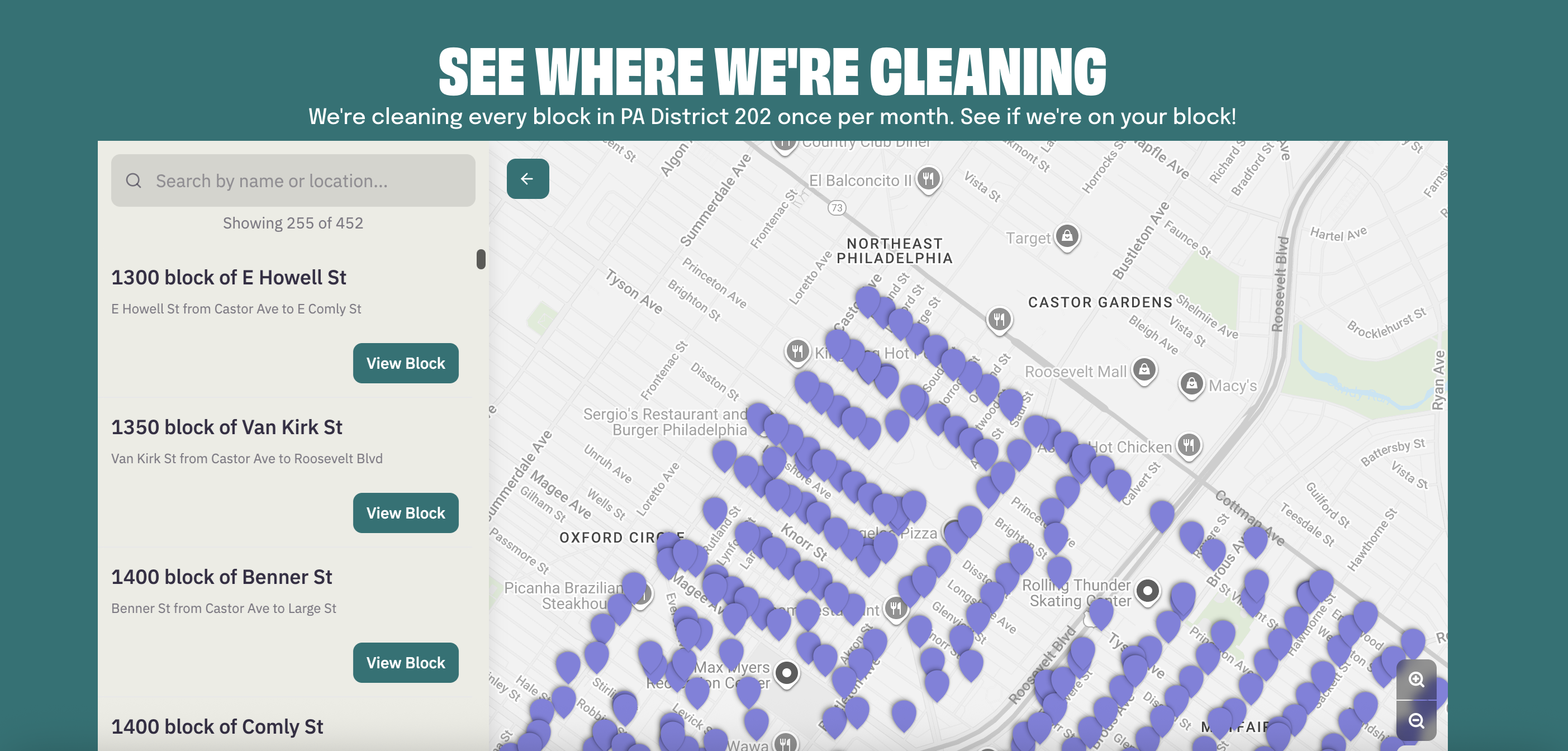
Initial user flows mapped three entry points: Glitter's interactive marketing map, direct URL, and QR codes on physical street signs. Each needed to land a neighbor on the right block page and guide them to act.

Lo-fi wireframes moved into Softr's editor early, letting real platform constraints inform design before high-fidelity work began. User interviews using these builds generated directional and specific feedback, synthesized and prioritized to guide iteration.

I collaborated with the CEO and founder on user feedback sessions, synthesizing insights from a range of conversations with existing users, prospects, and community members. Not all feedback mapped directly to scope or technical feasibility, so a meaningful part of the work was translating raw input into prioritized, actionable design decisions, filtering for what was realistic within Softr's constraints and Glitter's data architecture, and building alignment around what to act on and what to set aside.

User flow mapping & wireframes in Figma

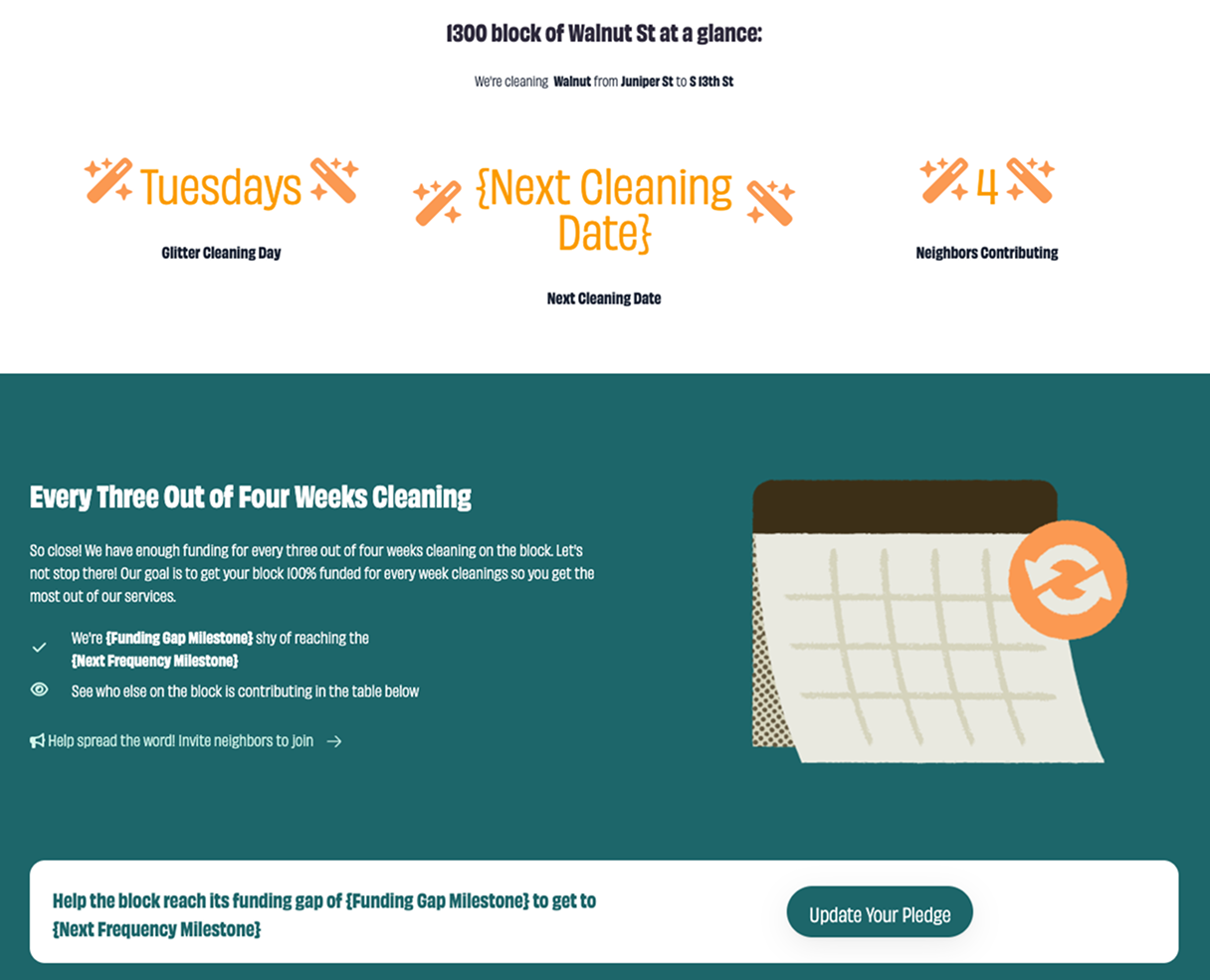
Lo-fi prototype in Softr editor — first iteration

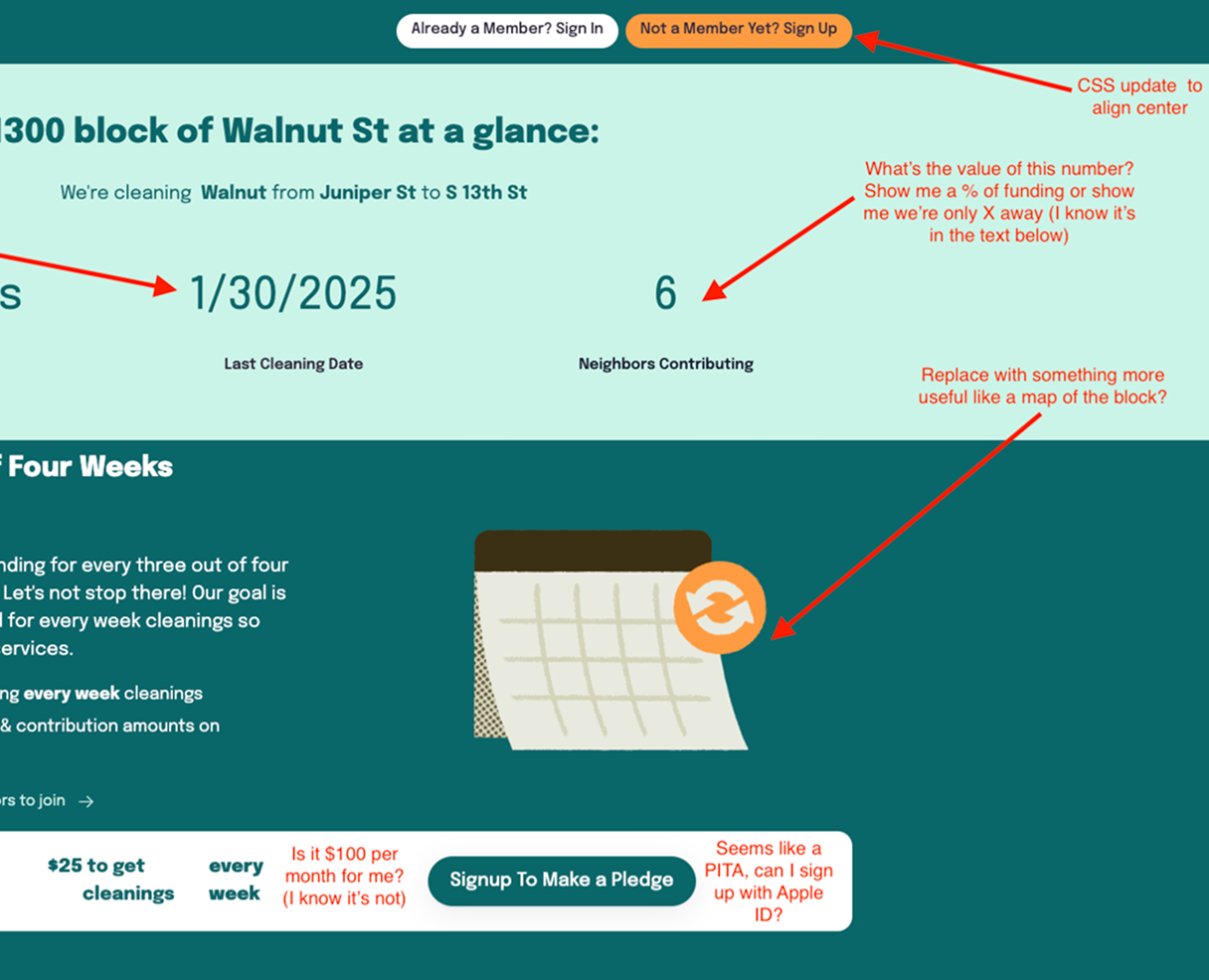
Marked-up user interview feedback from a long time subscriber

Agency Partnership & Recalibration

As early design concepts were developing, Glitter launched two large-scale grant-funded cleaning initiatives. My role expanded: stakeholder engagement, operations planning, community outreach, and integration of both initiatives into the app's data architecture.

To maintain momentum while managing parallel grant-funded initiatives, I collaborated with the founder on scoping and running an RFP process, evaluating Softr specialists, independent designers, and local agencies. I was present for every conversation and exchange, and advocated for the candidate I felt was best suited for the work, a Softr specialist with hands-on platform experience, data architecture knowledge, and some design and coding background.

We ultimately partnered with a local design agency whose designer had a strong grasp of the deliverables and scope, and brought graphic design experience to the asset creation work. I led onboarding, set collaboration parameters, and ran design reviews throughout the engagement.

As the work progressed, it became clear that the agency's limited experience with Softr and low-code platforms was creating friction between what was being designed and what could actually be implemented. Delivered assets required significant reworking to fit within the platform's constraints and align with the data architecture already in place. When the decision was made to step back from the engagement, I led the recalibration, took execution back in-house, and drove the work through to a shipped V1.

Agency user flow diagramming in FigJam

Proposed agency CTA assets — did not meet bar

High-Fidelity Build & Advanced Customization

With clearer alignment, I led the rebuild of the experience directly in Softr, working closely with the CEO through an iterative review process. I owned the end-to-end product management of the scope, documenting pages, sections, user flows, and data architecture considerations in Asana to keep the work on track. On the implementation side, I applied custom HTML and CSS for brand typography, window.record lookups to ensure dynamic data pulled accurately from Airtable, and AI-assisted illustration assets to fill visual gaps left by the agency, drawing on prior product design experience to guide accessibility considerations and platform-specific decisions throughout.

Design Transition: Partnering With A Third-Party Agency

As early design concepts were taking shape, Glitter was preparing to launch two large-scale grant-funded cleaning initiatives. My role expanded to oversee stakeholder engagement, operations and logistics planning, community outreach, and the integration of these projects into Airtable and, ultimately, the web app.

To maintain momentum while the product remained in a pre-MVP stage and ensure alignment with brand and technical needs, we partnered with a digital product agency to help bring the experience forward.

Collaborative Strategy

With the initial structure in place, Glitter and the agency aligned on a scope focused on developing new brand assets, refining UX and user flows, and translating wireframes into Softr’s dynamic and static components, including custom code where needed. The collaboration began with a comprehensive walkthrough of the business and the Softr editor to ground the work in platform realities. Regular design reviews were conducted both one-on-one and with leadership to ensure alignment as the work progressed.

Recalibrating Our Approach

It became clear that alignment across stakeholder vision, platform constraints, and practical realities was essential before further design work could continue. We paused, reassessed the direction, and ultimately made the decision to step back and recalibrate our approach.

Design Context, Part two: back to the drawing board

With clearer alignment and renewed focus, we returned to the core structure, iterating on what was working, refining what wasn’t, and rebuilding directly within Softr. This phase emphasized thoughtful execution, deeper customization, and a tighter connection between data architecture, brand, and user experience.

Where previously delivered assets fell short of expectations, we leveraged AI-assisted tools to generate adaptable visual components that, while not identical to the original Smith & Diction brand work, provided a cohesive and flexible extension of the identity within the web app. Additional refinement came through implementing targeted custom code, including window record lookups, to ensure dynamic data was pulled accurately and updates required minimal manual intervention.

High-fidelity design in the Softr editor

Designed polished dynamic and static templatized mockups that would scale to 1,000+ city blocks in Glitter’s database

Advanced Customization

Extended Softr's out-of-the-box capabilities with custom HTML/CSS and window.record lookups

Key feature

How might we build trust and increase visibility while streamlining onboarding for new city blocks and users?

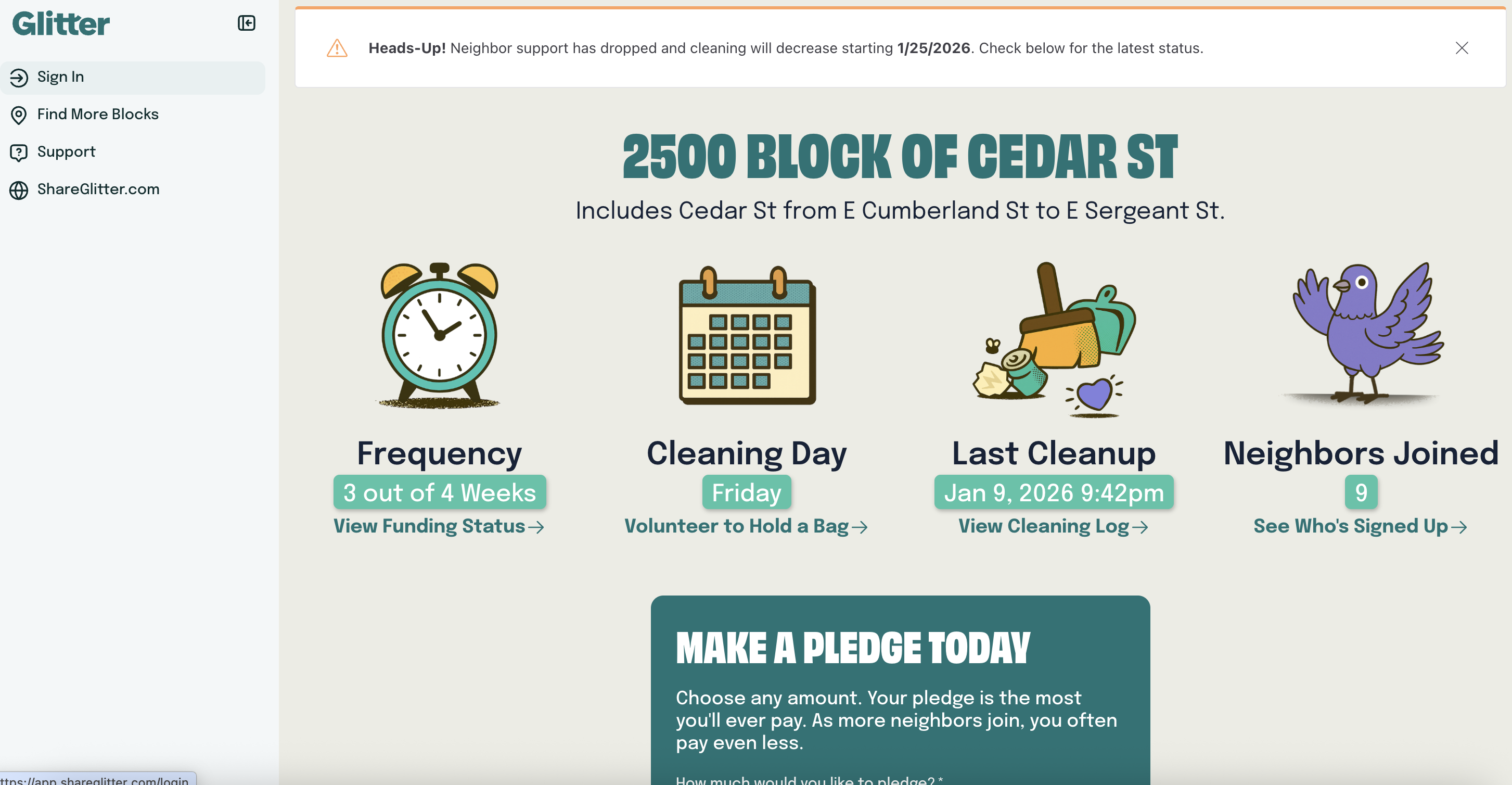
The clearest expression of the design work is the transformation of Glitter's block pages — from static, hand-built pledge pages to dynamic, data-driven block profiles.

Before: Static Pledge Pages

  • Hand-built per block, no real-time data

  • Manual image uploads & monetary adjustments

  • No conditional content or permissions

  • Scaling was operationally impossible

After: Dynamic Page Templates

  • Auto-generated from Airtable data

  • Real-time funding status & cleaning history

  • Conditional visibility & permission-based access

  • Scales to 1,000+ city blocks and users

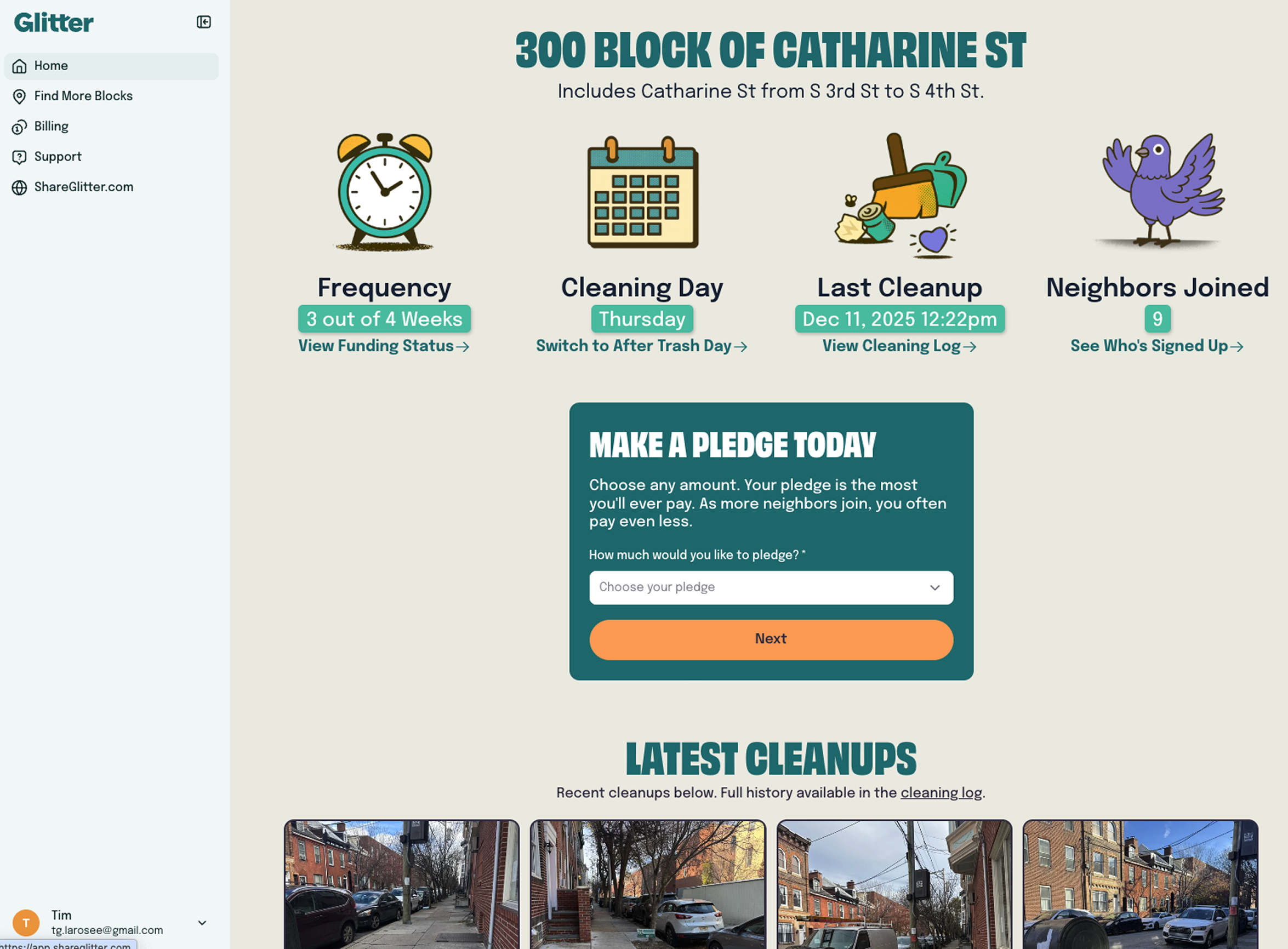
The public view of a city block’s page provides clear, block-specific details while introducing Glitter’s broader services, helping users easily imagine what the program could look like on their own block. The page is accessible through multiple entry points, whether users arrive via the interactive map on Glitter's web page or by scanning a QR code on a street sign.

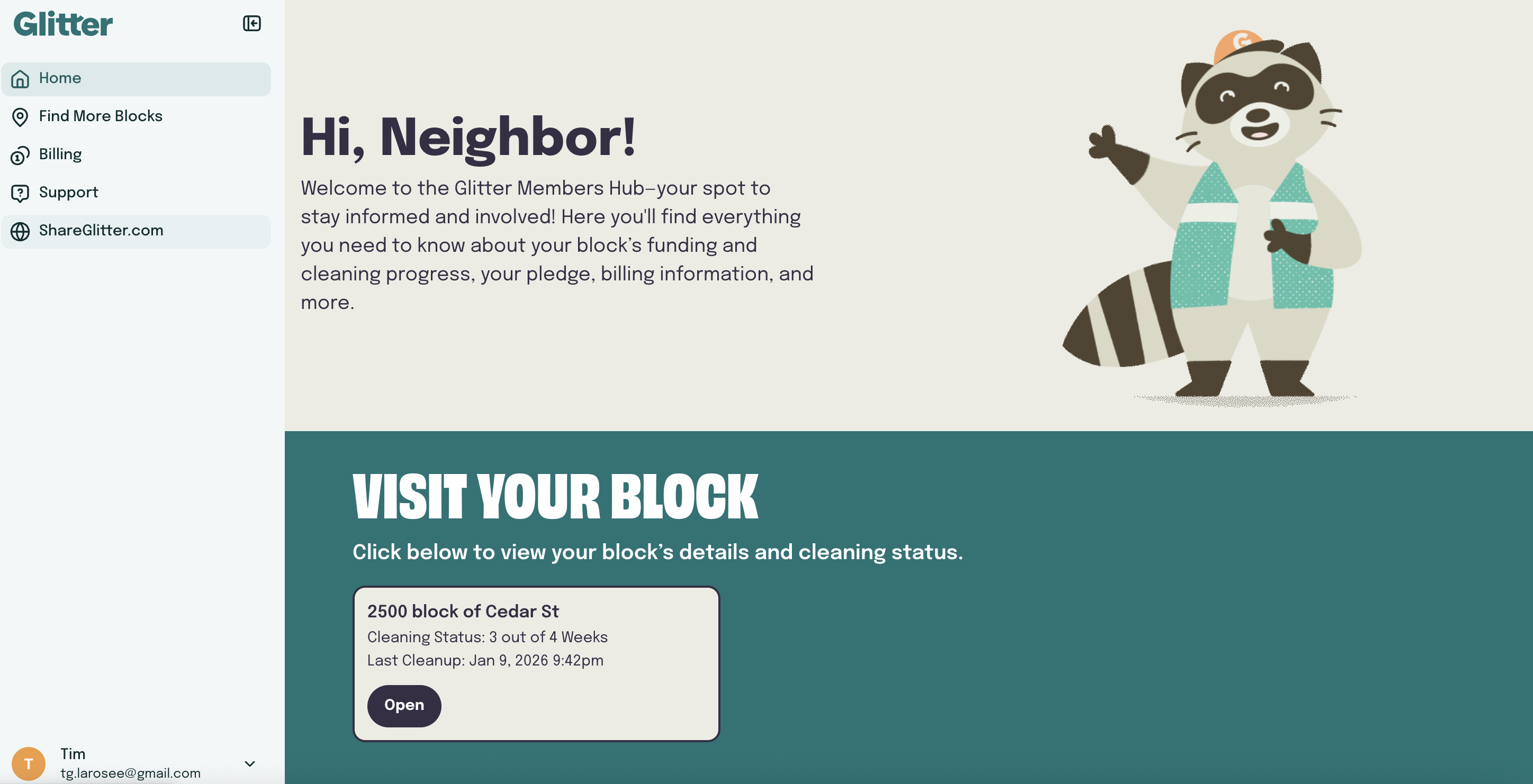
Once signed in, users are brought to a personalized dashboard that conditionally reflects their block association based on their account. Visual cues, like the waving raccoon mascot and block-specific UI cards, reinforce correct identification and give users clear access to detailed block information.

Grant-funded blocks are surfaced alongside neighbor-funded blocks through the same templated, conditionally driven system. By planning for their inclusion in the database, Glitter made large-scale grant-funded initiatives visible, allowing residents to opt in to additional pledges to support expanded cleaning.

feature Spotlight

Real-Time Cleaning Photo Feed

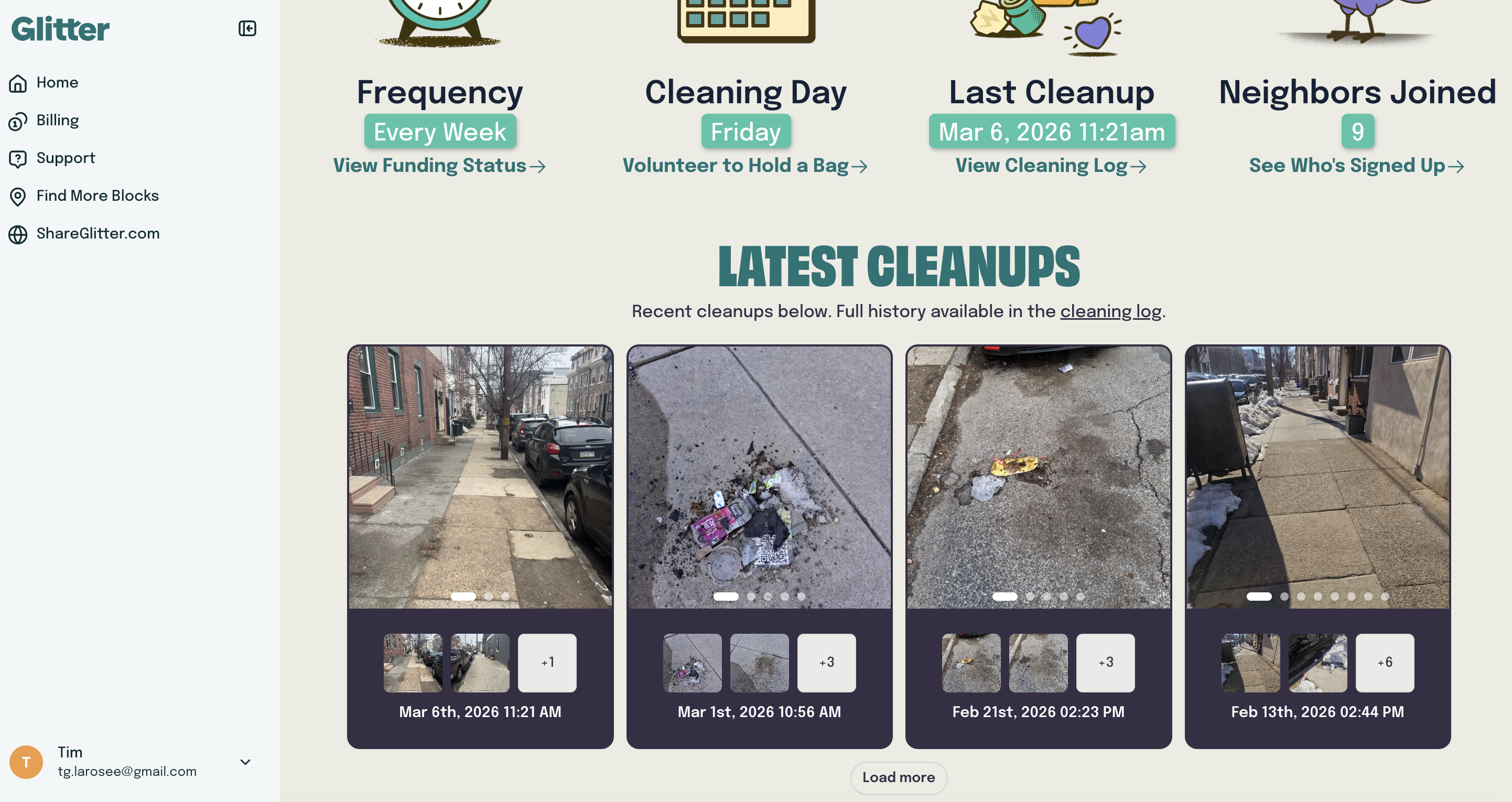
After cleanings, Glitter cleaners submit photos through a Trello-based workflow, which flows into Airtable and surfaces block-by-block in the member portal through Softr. The design challenge was hierarchy: how do you surface this content prominently without making it the entire page?

Within Softr's constraints, we tested both horizontal scroll and a card-based layout with a load more option. Horizontal scroll created an infinite feed of cleaning photos, and while the accountability value is real, the content itself is photos of trash. Each week brings new trash. Surfacing years of it in a continuous scroll worked against the experience rather than for it.

We landed on a fixed set of UI cards with a load more button, giving users agency without defaulting to infinity. For logged-in users who want more legacy info, a cleaning log table displays all historical records from latest to earliest, keeping the detail available without putting it in everyone's path.

Real-time cleaning photo feed — block-specific, automatically updated

Key Feature: Dynamic page templates

How Might we build trust and increase visibility while streamlining onboarding for new city blocks and users?

Previously, Glitter relied on a manual, time-consuming workflow that made scaling difficult. Each new city block or user required hand-creating fundraising pages, uploading images, and manually adjusting contribution amounts, slowing onboarding and limiting visibility for end users.

We designed scalable page templates that dynamically pull data across 1,000+ city blocks in Glitter's database, conditionally displaying block details, funding contributions, and cleaning status to improve transparency and accelerate onboarding.

Before: Static Pledge Pages

  • Manual updates required for each block, no real-time data

After: Dynamic Page Templates

  • Real-time data, conditional visibility, permission-based access

The public view of a city block’s page provides clear, block-specific details while introducing Glitter’s broader services, helping users easily imagine what the program could look like on their own block.

The page is accessible through multiple entry points, whether users arrive via the interactive map on Glitter's web page or by scanning a QR code on a street sign.
Once signed in, users are brought to a personalized dashboard that conditionally reflects their block association based on their account. Visual cues, like the waving raccoon mascot and block-specific UI cards, reinforce correct identification and give users clear access to detailed block information.
Grant-funded blocks are surfaced alongside neighbor-funded blocks through the same templated, conditionally driven system. By planning for their inclusion in the database, Glitter made large-scale grant-funded initiatives visible, allowing residents to opt in to additional pledges to support expanded cleaning.
Collaboration

Designing at scale requires more than design.

Internal Stakeholder alligment

Partnered closely with leadership to align on vision, goals, and constraints. Through ongoing prioritization and trade-offs, design decisions balanced business needs with scalability and long-term maintainability.

User research and validation

Facilitated user interviews with leadership and synthesized insights to surface trust signals, clarity gaps, and onboarding friction. Research findings and ongoing feedback informed product and design decisions, balancing user needs with technical and data constraints.

Operational and cleaner feedback

Collaborated with operations and cleaners to understand on-the-ground workflows and constraints. Their input surfaced edge cases and operational realities that directly shaped data visibility, content hierarchy, and system design.

Platform and partner collaboration

Worked directly with the Softr team to navigate platform constraints and capabilities. These discussions shaped implementation decisions around dynamic data, templates, and custom code integrations to ensure scalability and a consistent product experience.

With a little help from our friends

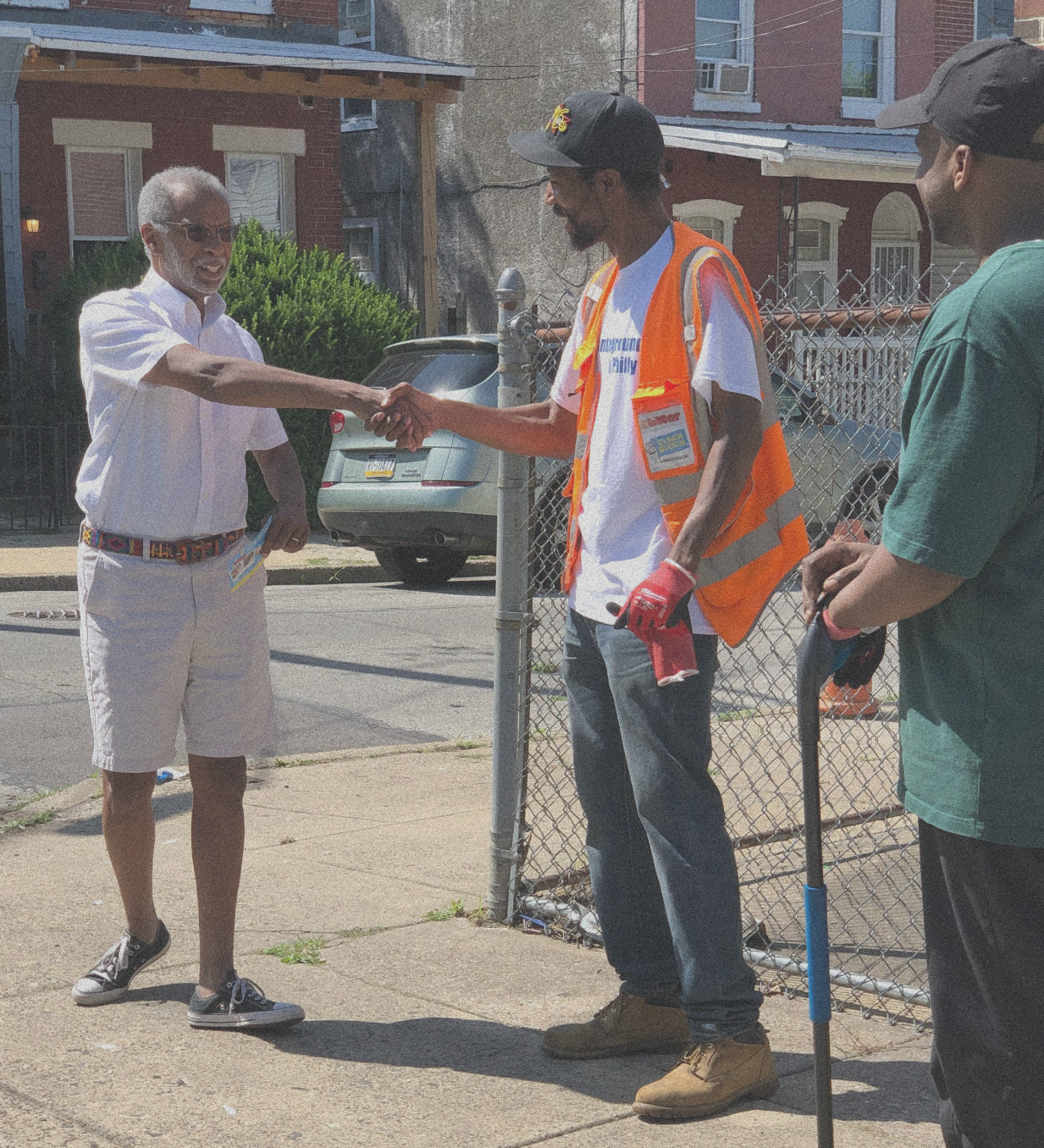
It paid off to build a strong relationship with the Softr team that went beyond customer success and engineering and into marketing. Together, we shipped a product they were proud to showcase — resulting in Softr’s first in-person, video-documented customer case study for their customer story series.

Collaboration and Impact
Designing at scale required collaboration across teams, stakeholders, and users

This work was shaped through close collaboration with internal stakeholders, operations, and external stakeholder partners. Input from cleaners, user interviews, and the Softr team directly informed design decisions, ensuring the solution worked in real-world workflows, not just in theory.

Internal Stakeholder alligment

Partnered closely with leadership to align on vision, goals, and constraints. Through ongoing prioritization and trade-offs, design decisions balanced business needs with scalability and long-term maintainability.

Operational and cleaner feedback

Collaborated with operations and cleaners to understand on-the-ground workflows and constraints. Their input surfaced edge cases and operational realities that directly shaped data visibility, content hierarchy, and system design.

User research and validation

Facilitated user interviews with leadership and synthesized insights to surface trust signals, clarity gaps, and onboarding friction. Research findings and ongoing feedback informed product and design decisions, balancing user needs with technical and data constraints.

Platform and partner collaboration

Worked directly with the Softr team to navigate platform constraints and capabilities. These discussions shaped implementation decisions around dynamic data, templates, and custom code integrations to ensure scalability and a consistent product experience.

Results

What shipped and what it produced.

Launched a fully dynamic, on-brand member hub serving 1,000+ city blocks — each auto-generated from a single data source

Eliminated manual page creation entirely — new city blocks onboard automatically through the data architecture

Improved neighbor trust and visibility through real-time block data, cleaning photo history, and personalized dashboards

Selected by Softr as their first in-person, video-documented customer case study — recognition that extended well beyond Glitter's user base

Established a design system and component library that supports ongoing iteration without starting from scratch

learnings
Putting a Lid on It (For Now)

Things I'd carry into the next build — on craft, constraints, and what it actually takes to ship something that feels right.